

You’ll maximize your plastic surgery landing page conversions by systematically testing high-impact elements like before-and-after photos, testimonials, and call-to-action buttons. Start with quick wins—button colors and headline variations—while confirming you’re gathering data from at least 1,000 users per variant for statistical significance. Focus your testing budget on pages promoting your highest-value procedures, and use tools that integrate smoothly with your analytics platform while maintaining HIPAA compliance. This strategic approach can boost consultation requests by 30-50% when you understand which testing methodologies and optimization frameworks deliver the strongest ROI for your practice.
Understanding A/B Testing Fundamentals for Plastic Surgery Practices
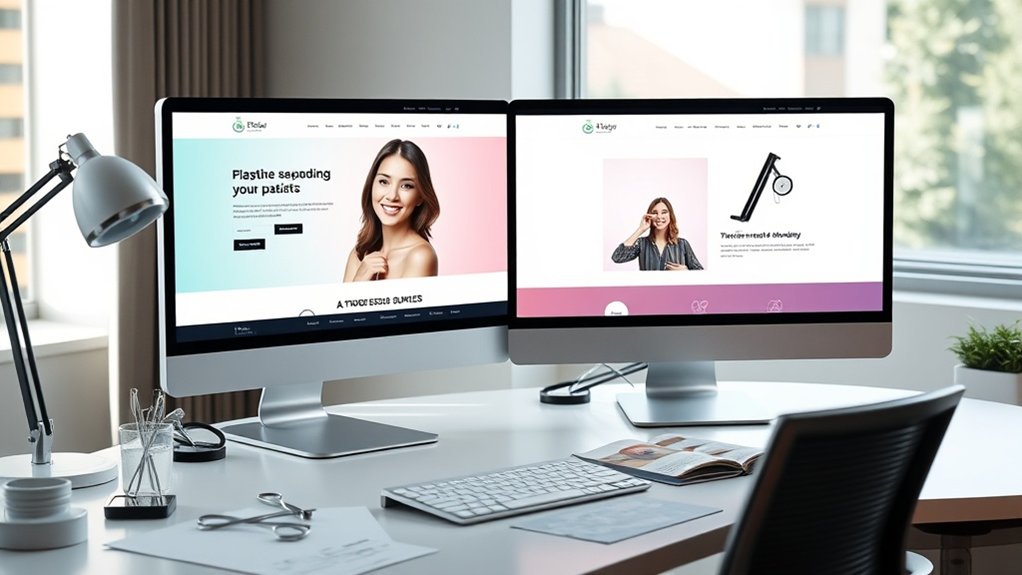
When you invest in digital marketing for your plastic surgery practice, A/B testing transforms guesswork into data-driven decisions that directly impact your bottom line.
This method compares two variations of your landing page—a control version (A) against a variant (B)—to determine which drives higher conversion rates. You’ll test key elements like client testimonials, before-and-after images, headlines, and call-to-action buttons to boost user engagement while maintaining HIPAA compliance.
Statistical significance matters: you need at least 1,000 users per variant weekly to guarantee results aren’t random chance. By systematically testing these variations, you’ll identify what resonates with potential patients and optimize landing pages for maximum performance.
The outcome? Increased patient inquiries and improved landing page performance that justify your marketing investment.
Prioritizing Tests Based on Impact and Available Resources
You’ll need sufficient traffic volume to reach statistical significance—typically at least 1,000 visitors per variation—before drawing reliable outcomes from your tests.
Focus first on pages that drive the highest-value procedures, as a 2% conversion lift on rhinoplasty consultations generates far greater revenue than the same lift on injectable inquiries.
Prioritize quick wins like button colors and headline variations that require minimal development time, then graduate to more complex long-term tests once you’ve established a testing framework and documented early ROI.
Assess Traffic Volume Requirements
Here’s your traffic assessment framework:
| Traffic Tier | Monthly Visitors | Testing Approach | Expected Timeline |
|---|---|---|---|
| Ideal | 10,000+ | Multiple concurrent tests | 2-4 weeks |
| Viable | 5,000-10,000 | Sequential testing only | 4-8 weeks |
| Challenging | 2,000-5,000 | Focus on high-traffic pages | 8-12 weeks |
| Insufficient | <2,000 | Delay testing | N/A |
Use calculators to determine appropriate test duration and sample size and test duration before analyzing results, confirming user engagement and conversion metrics guide your decisions.
Evaluate Potential Revenue Impact
Use analytics tools to identify critical optimization opportunities.
Your call-to-action buttons typically deliver 20-30% conversion lifts with minimal testing resources. Elements influencing patient decision-making—like testimonials and before-after galleries—can boost conversions by 80%.
Calculate testing ROI by multiplying expected conversion gains against procedure values and traffic volume.
Prioritize tests on your highest-performing landing page first, then scale successful patterns.
Understanding user behavior through data guarantees you’re investing testing resources where they’ll generate maximum returns while maintaining compliance standards.
Balance Quick Wins vs. Long-Term Tests
While surgical practices often rush to test everything simultaneously, strategic prioritization separates profitable campaigns from wasted budgets.
Start A/B testing with quick wins—optimize headlines and CTAs on high-traffic pages where you’ll see immediate conversion rates improvements. These low-effort changes deliver fast user engagement boosts while you’re building momentum.
However, don’t ignore long-term tests. Testing your landing pages with complex variations like layout redesigns requires patience to reach statistical significance, but they’ll drive sustained growth.
Use data-driven prioritization through analytics to identify which elements warrant immediate attention versus extended testing periods.
Allocate resources smartly: implement quick wins rapidly while maintaining structured timelines for thorough tests. This balanced approach guarantees you’re capturing immediate conversions without sacrificing strategic, high-impact optimizations that compound revenue over time.
Critical Landing Page Elements to Test for Maximum Conversions
Your landing page’s performance hinges on three high-impact elements that directly influence whether prospects convert into consultations.
By systematically testing your headlines and hero images, CTA buttons, and consultation form fields, you’ll identify which variations drive the strongest ROI while maintaining HIPAA-compliant patient communication standards.
These elements collectively control your first impression, user engagement, and form completion rates—the critical conversion path for plastic surgery practices.
Headlines and Hero Images
Because your headline and hero image occupy the most valuable real estate on your landing page, they’ll determine whether visitors stay or leave within seconds.
A/B testing these elements can dramatically impact conversion rates—compelling headlines boost user engagement by up to 80%, while high-quality images increase conversions by 20-30%.
Test headlines that present clear value propositions, like “Achieve Your Dream Look with Our Expert Surgeons,” against generic alternatives.
You’ll find that concise headlines under 10 words generate higher click-through rates than complex phrases.
For hero images, replace stock photos with authentic before-and-after images showcasing real patient results.
This approach builds trust and credibility with potential clients who need to visualize actual outcomes.
Remember to maintain HIPAA compliance when using patient photography in your testing variations.
Call-to-Action Button Optimization
After capturing attention with your headline and hero image, you’ll need to convert that interest into action through strategic CTA button optimization.
A/B testing call-to-action buttons reveals specific elements that dramatically impact conversion rates on your landing page.
Test these critical CTA components:
- Button color: Contrasting colors increase visibility and can boost click-through rates by 21%, making your CTA impossible to miss.
- Action-oriented phrases: Replace generic text like “Submit” with compelling phrases such as “Get Your Free Consultation” to drive engagement.
- Button size: Optimize for 44-48 pixels height on mobile devices to guarantee accessibility while drawing attention.
- Urgency messaging: Include phrases like “Limited Time Offer!” to create scarcity, potentially increasing click-through rates by 30%.
Position buttons above the fold for 50% more clicks while maintaining HIPAA-compliant messaging.
Consultation Form Field Testing
While your CTA buttons drive initial engagement, consultation form fields determine whether prospects actually convert into qualified leads. A/B testing your consultation form reveals which landing page elements maximize conversion rates.
Start by testing field quantity—reducing from 11 to 4 fields can increase conversions by 120%. Next, experiment with field types: dropdowns versus text inputs greatly impact user experience and completion rates.
Implement inline validation to provide real-time feedback, potentially boosting form submissions by 30%. Test form placement above versus below the fold to optimize visibility.
Finally, refine your CTA wording within forms—changing “Submit” to “Get My Free Consultation” can increase conversions by 25%. Each test identifies friction points where users abandon, enabling you to refine the path from interest to qualified consultation bookings.
Choosing the Right Testing Methodology for Your Practice
Before you invest time and resources into testing your plastic surgery landing pages, you’ll need to match your methodology to your practice’s specific goals and traffic patterns.
Here’s how to select the right approach:
- Use A/B testing when comparing two landing pages variations to determine which drives higher conversion rates for specific procedures.
- Make use of split testing for significant design changes like complete layout overhauls that impact appointment bookings and user engagement.
- Implement multivariate testing to experiment with multiple elements—headlines, images, CTAs—simultaneously to identify the most effective combination.
- Assure minimum sample size of 1,000 users per variant weekly for statistically significant results.
Establish measurable goals for each test, such as increasing consultation requests by a specific percentage, to optimize your plastic surgery landing pages effectively.
Selecting and Implementing A/B Testing Tools

Once you’ve identified your testing methodology, you’ll need tools that deliver accurate data while protecting patient privacy under HIPAA regulations.
Platforms like Optimizely and AB Tasty offer user-friendly interfaces with no-code editing features, enabling you to create landing page variants without technical expertise. Prioritize tools with robust analytics capabilities that integrate smoothly with Google Analytics for thorough conversion tracking.
Your chosen solution should include A/B testing calculators to determine appropriate sample size and test duration for achieving statistical significance—critical when working with limited visitor traffic.
Look for heatmap and session replay functionalities that visualize patient interactions, revealing optimization opportunities. These features help you identify which elements drive consultations while assuring every test delivers measurable ROI and maintains compliance with healthcare privacy standards.
Analyzing Results and Scaling Your Testing Program
When your A/B test reaches statistical significance—typically requiring at least 1,000 users per variant per week—you’ll need to examine conversion rates and engagement metrics with surgical precision.
Your scaling testing program roadmap:
- Segment by demographics to identify age and gender-specific preferences that drive conversion rates, enabling targeted marketing campaigns.
- Document test outcomes in a centralized knowledge base to inform future hypotheses and maintain compliance with healthcare advertising regulations.
- Analyze user engagement metrics across high-performing variants to understand which elements truly resonate with potential patients.
- Systematically use winning elements across additional landing pages and channels while maintaining consistent messaging.
This data-driven approach transforms A/B testing from isolated experiments into a scalable framework that continuously improves patient acquisition while respecting medical marketing compliance requirements.